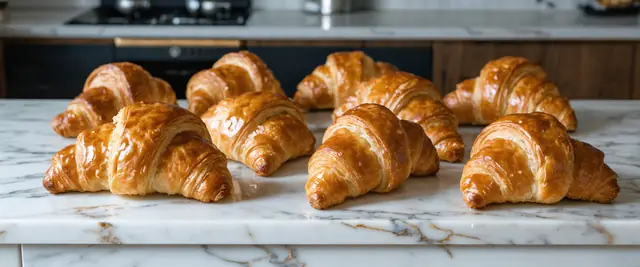
Croissants
Layers of buttery dough puff into flaky, golden crescents through careful folding and chilling.
Dietary
Vegetarian, Pescatarian, Nut free, Halal, Kosher
Allergens
Dairy, Eggs, Wheat
This laminated dough builds dozens of thin butter layers through a series of folds and rests, producing a pastry that shatters into flaky shards with a tender, airy crumb inside. The process spans two days but most of that time is passive chilling, making it manageable for a weekend baking project. Serve warm with jam or simply plain alongside coffee.
Ingredients
- 4 cups all-purpose flour
- 1/4 cup granulated sugar
- 2 1/4 teaspoons instant yeast
- 2 teaspoons fine sea salt
- 1 1/4 cups whole milk, cold
- 2 tablespoons unsalted butter, softened
- 2 cups unsalted butter, cold (for lamination block)
- 1 egg, beaten with 1 tablespoon water, for egg wash
Method
-
In a large bowl or stand mixer, whisk together the flour, sugar, instant yeast, and salt.
-
Add the cold milk and softened butter, then mix on low speed until a rough dough forms, about 3 minutes. It will look shaggy, not smooth.
-
Turn the dough out and knead briefly by hand just until it comes together, about 1 minute. Do not overwork it.
-
Shape the dough into a rough 7-inch square, wrap tightly in plastic, and refrigerate.
-
Meanwhile, prepare the butter block: place the cold butter between two sheets of parchment and pound and roll it into a 7-inch square of even thickness. Refrigerate until firm but pliable.
-
On a lightly floured surface, roll the chilled dough into a 10-inch square.
-
Place the butter block diagonally on the dough so its corners point to the middle of each dough edge, then fold the dough corners up over the butter, sealing it completely inside like an envelope.
-
Roll the sealed dough into a rectangle roughly 8 by 20 inches, dusting with flour as needed to prevent sticking.
-
Perform a letter fold: fold one short end two-thirds of the way across, then fold the other end over it, like folding a letter. Wrap and refrigerate.
-
Repeat the rolling to an 8 by 20-inch rectangle and letter fold two more times, chilling for 45 minutes between each fold, for a total of three folds.
-
After the final fold, wrap the dough and refrigerate for at least 4 hours or overnight to fully relax the gluten.
-
Roll the chilled dough into a large rectangle about 9 by 28 inches and 1/4 inch thick, trimming the edges straight.
-
Cut the dough into 12 long triangles with a 4-inch wide base, using a ruler and sharp knife or pizza cutter for clean edges.
-
Make a small notch in the center of each triangle's base, then roll each triangle up from the base to the tip, curving the ends slightly inward into a crescent shape.
-
Arrange the shaped croissants on two parchment-lined baking sheets, spaced well apart, cover loosely, and let rise in a warm spot until puffy and nearly doubled.
-
Preheat the oven to 400°F.
-
Brush the risen croissants gently with egg wash, taking care not to deflate the layers.
-
Bake until deep golden brown and crisp, 18 to 22 minutes, rotating the pans halfway through for even color.
-
Transfer to a wire rack and cool at least 15 minutes before serving to let the interior layers set.
Rate this recipe
Report this comment

Croissants
This laminated dough builds dozens of thin butter layers through a series of folds and rests, producing a pastry that shatters into flaky shards with a tender, airy crumb inside. The process spans two days but most of that time is passive chilling, making it manageable for a weekend baking project. Serve warm with jam or simply plain alongside coffee.
21 hr 12 croissants 340 cal
Ingredients
- 4 cups all-purpose flour
- 1/4 cup granulated sugar
- 2 1/4 teaspoons instant yeast
- 2 teaspoons fine sea salt
- 1 1/4 cups whole milk, cold
- 2 tablespoons unsalted butter, softened
- 2 cups unsalted butter, cold (for lamination block)
- 1 egg, beaten with 1 tablespoon water, for egg wash
Method
- 1
In a large bowl or stand mixer, whisk together the flour, sugar, instant yeast, and salt.
- 2
Add the cold milk and softened butter, then mix on low speed until a rough dough forms, about 3 minutes. It will look shaggy, not smooth.
- 3
Turn the dough out and knead briefly by hand just until it comes together, about 1 minute. Do not overwork it.
- 4
Shape the dough into a rough 7-inch square, wrap tightly in plastic, and refrigerate.
- 5
Meanwhile, prepare the butter block: place the cold butter between two sheets of parchment and pound and roll it into a 7-inch square of even thickness. Refrigerate until firm but pliable.
- 6
On a lightly floured surface, roll the chilled dough into a 10-inch square.
- 7
Place the butter block diagonally on the dough so its corners point to the middle of each dough edge, then fold the dough corners up over the butter, sealing it completely inside like an envelope.
- 8
Roll the sealed dough into a rectangle roughly 8 by 20 inches, dusting with flour as needed to prevent sticking.
- 9
Perform a letter fold: fold one short end two-thirds of the way across, then fold the other end over it, like folding a letter. Wrap and refrigerate.
- 10
Repeat the rolling to an 8 by 20-inch rectangle and letter fold two more times, chilling for 45 minutes between each fold, for a total of three folds.
- 11
After the final fold, wrap the dough and refrigerate for at least 4 hours or overnight to fully relax the gluten.
- 12
Roll the chilled dough into a large rectangle about 9 by 28 inches and 1/4 inch thick, trimming the edges straight.
- 13
Cut the dough into 12 long triangles with a 4-inch wide base, using a ruler and sharp knife or pizza cutter for clean edges.
- 14
Make a small notch in the center of each triangle's base, then roll each triangle up from the base to the tip, curving the ends slightly inward into a crescent shape.
- 15
Arrange the shaped croissants on two parchment-lined baking sheets, spaced well apart, cover loosely, and let rise in a warm spot until puffy and nearly doubled.
- 16
Preheat the oven to 400°F.
- 17
Brush the risen croissants gently with egg wash, taking care not to deflate the layers.
- 18
Bake until deep golden brown and crisp, 18 to 22 minutes, rotating the pans halfway through for even color.
- 19
Transfer to a wire rack and cool at least 15 minutes before serving to let the interior layers set.
Comments
Log in to comment.