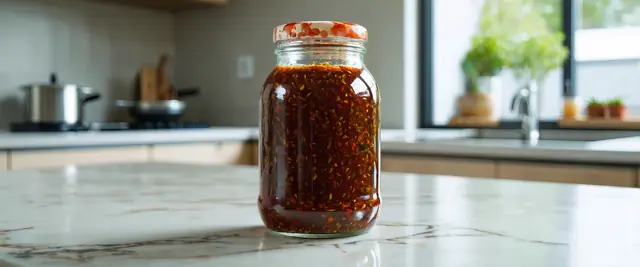
Doubanjiang Chili Paste
A pungent, salty fermented broad bean paste that anchors Sichuan cooking with deep umami heat.
Dietary
Vegan, Vegetarian, Pescatarian, Wheat free, Dairy free, Nut free, Kosher
Allergens
Soy
This quick-fermented style doubanjiang builds savory depth from broad beans, chiles, and koji-style fermentation shortcuts using miso as a base. It delivers the salty, funky, umami-rich foundation essential for mapo tofu, twice-cooked pork, and countless Sichuan stir-fries. Unlike traditional versions that ferment for months, this adaptation captures similar complexity in a fraction of the time.
Ingredients
- 1 cup dried broad beans (fava beans), split and skinned
- 1/2 cup yellow soybean miso paste
- 1/3 cup dried Sichuan facing-heaven chiles, stemmed and seeded
- 1/4 cup Sichuan chile flakes (coarse ground)
- 1/4 cup shaoxing wine
- 3 tablespoons coarse salt
- 2 tablespoons neutral vegetable oil
- 1 tablespoon sugar
- 1/4 cup warm water
Method
-
Soak the split broad beans in water for 8 hours or overnight until fully softened.
-
Drain the beans and steam them over boiling water in a covered steamer basket for 40 minutes, until tender and easily mashed.
-
While the beans steam, cover the dried chiles with hot water in a small bowl and let soak for 20 minutes to soften.
-
Drain the softened chiles and pulse them in a food processor with the chile flakes until a coarse paste forms.
-
Mash the steamed beans with a fork or potato masher until mostly smooth, leaving some texture.
-
In a large bowl, combine the mashed beans, miso paste, chile paste, salt, sugar, and shaoxing wine, stirring until evenly blended.
-
Stir in the warm water a little at a time until the mixture reaches a thick, spreadable, jam-like consistency.
-
Pack the mixture into a clean glass jar, pressing down to remove air pockets, and pour the oil over the surface to seal it from air.
-
Cover the jar loosely with cheesecloth secured by a rubber band and let it ferment at room temperature away from direct light for 3 days, stirring once daily and re-topping with a thin layer of oil each time.
-
Taste the paste; it should be salty, funky, and deeply savory. Transfer to a sealed jar and refrigerate for up to 6 months, using as needed in cooked dishes.
Rate this recipe

Doubanjiang Chili Paste
This quick-fermented style doubanjiang builds savory depth from broad beans, chiles, and koji-style fermentation shortcuts using miso as a base. It delivers the salty, funky, umami-rich foundation essential for mapo tofu, twice-cooked pork, and countless Sichuan stir-fries. Unlike traditional versions that ferment for months, this adaptation captures similar complexity in a fraction of the time.
Make ahead 16 oz 35 cal
Ingredients
- 1 cup dried broad beans (fava beans), split and skinned
- 1/2 cup yellow soybean miso paste
- 1/3 cup dried Sichuan facing-heaven chiles, stemmed and seeded
- 1/4 cup Sichuan chile flakes (coarse ground)
- 1/4 cup shaoxing wine
- 3 tablespoons coarse salt
- 2 tablespoons neutral vegetable oil
- 1 tablespoon sugar
- 1/4 cup warm water
Method
- 1
Soak the split broad beans in water for 8 hours or overnight until fully softened.
- 2
Drain the beans and steam them over boiling water in a covered steamer basket for 40 minutes, until tender and easily mashed.
- 3
While the beans steam, cover the dried chiles with hot water in a small bowl and let soak for 20 minutes to soften.
- 4
Drain the softened chiles and pulse them in a food processor with the chile flakes until a coarse paste forms.
- 5
Mash the steamed beans with a fork or potato masher until mostly smooth, leaving some texture.
- 6
In a large bowl, combine the mashed beans, miso paste, chile paste, salt, sugar, and shaoxing wine, stirring until evenly blended.
- 7
Stir in the warm water a little at a time until the mixture reaches a thick, spreadable, jam-like consistency.
- 8
Pack the mixture into a clean glass jar, pressing down to remove air pockets, and pour the oil over the surface to seal it from air.
- 9
Cover the jar loosely with cheesecloth secured by a rubber band and let it ferment at room temperature away from direct light for 3 days, stirring once daily and re-topping with a thin layer of oil each time.
- 10
Taste the paste; it should be salty, funky, and deeply savory. Transfer to a sealed jar and refrigerate for up to 6 months, using as needed in cooked dishes.