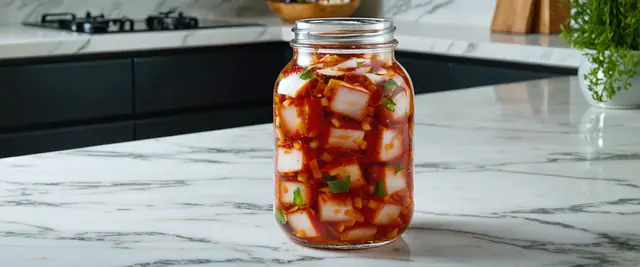
Radish Kimchi
Crunchy cubed radishes ferment in a spicy, garlicky brine into tangy kkakdugi.
Dietary
Pescatarian, Wheat free, Dairy free, Nut free, Halal
Allergens
Fish, Shellfish
This Korean radish kimchi salts and drains cubed daikon before coating it in a paste of gochugaru, garlic, ginger, and fish sauce. Left to ferment at room temperature for a few days, it develops a crisp, tangy crunch that pairs well with rice, stews, or grilled meats.
Ingredients
- 2 pounds Korean radish or daikon, peeled and cut into 3/4-inch cubes
- 2 tablespoons coarse sea salt
- 1 tablespoon granulated sugar
- 3 tablespoons gochugaru (Korean red pepper flakes)
- 2 tablespoons fish sauce
- 1 tablespoon salted shrimp (saeujeot), minced
- 4 cloves garlic, minced
- 1 teaspoon ginger, minced
- 3 scallions, cut into 1-inch pieces
- 1 teaspoon granulated sugar
Method
-
Place the cubed radish in a large bowl and sprinkle with the coarse sea salt and 1 tablespoon sugar, tossing to coat evenly.
-
Let the radish sit at room temperature, tossing once or twice, until it releases liquid and softens slightly.
-
Drain the radish well in a colander, reserving 2 tablespoons of the released liquid; discard the rest.
-
In a small bowl, whisk together the reserved radish liquid, gochugaru, fish sauce, minced salted shrimp, garlic, ginger, and remaining 1 teaspoon sugar to form a thick paste.
-
Add the drained radish and scallions to the paste and toss with your hands or a spoon until every cube is evenly coated in red seasoning.
-
Pack the seasoned radish tightly into a clean quart-sized jar, pressing down so any liquid rises to cover the top.
-
Cover loosely and let the jar sit at room temperature, away from direct sunlight, to ferment.
-
Check the kimchi daily, pressing radish back under the brine; once bubbly and tangy to taste, move the jar to the refrigerator.
-
Refrigerate for at least 1 day before serving to let the flavors mellow; keeps well for several weeks, growing more tangy over time.
Rate this recipe

Radish Kimchi
This Korean radish kimchi salts and drains cubed daikon before coating it in a paste of gochugaru, garlic, ginger, and fish sauce. Left to ferment at room temperature for a few days, it develops a crisp, tangy crunch that pairs well with rice, stews, or grilled meats.
Make ahead 8 servings 45 cal
Ingredients
- 2 pounds Korean radish or daikon, peeled and cut into 3/4-inch cubes
- 2 tablespoons coarse sea salt
- 1 tablespoon granulated sugar
- 3 tablespoons gochugaru (Korean red pepper flakes)
- 2 tablespoons fish sauce
- 1 tablespoon salted shrimp (saeujeot), minced
- 4 cloves garlic, minced
- 1 teaspoon ginger, minced
- 3 scallions, cut into 1-inch pieces
- 1 teaspoon granulated sugar
Method
- 1
Place the cubed radish in a large bowl and sprinkle with the coarse sea salt and 1 tablespoon sugar, tossing to coat evenly.
- 2
Let the radish sit at room temperature, tossing once or twice, until it releases liquid and softens slightly.
- 3
Drain the radish well in a colander, reserving 2 tablespoons of the released liquid; discard the rest.
- 4
In a small bowl, whisk together the reserved radish liquid, gochugaru, fish sauce, minced salted shrimp, garlic, ginger, and remaining 1 teaspoon sugar to form a thick paste.
- 5
Add the drained radish and scallions to the paste and toss with your hands or a spoon until every cube is evenly coated in red seasoning.
- 6
Pack the seasoned radish tightly into a clean quart-sized jar, pressing down so any liquid rises to cover the top.
- 7
Cover loosely and let the jar sit at room temperature, away from direct sunlight, to ferment.
- 8
Check the kimchi daily, pressing radish back under the brine; once bubbly and tangy to taste, move the jar to the refrigerator.
- 9
Refrigerate for at least 1 day before serving to let the flavors mellow; keeps well for several weeks, growing more tangy over time.