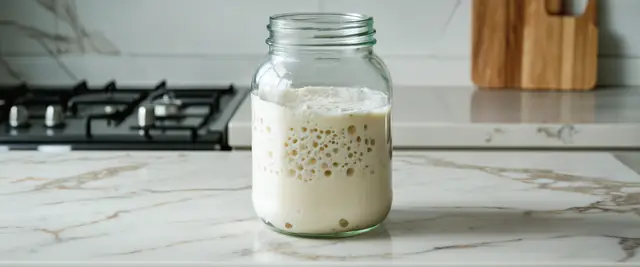
Sourdough Starter
A wild-yeast culture built from just flour and water, ready in about a week.
Dietary
Vegan, Vegetarian, Pescatarian, Dairy free, Nut free, Halal, Kosher
Allergens
Wheat
Fermenting flour and water over several days cultivates the wild yeast and bacteria that give sourdough bread its tangy flavor and airy crumb. Daily feedings build strength and activity until the starter reliably doubles in size, signaling it's ready to leaven bread. Once established, this starter can be maintained indefinitely with regular feedings.
Ingredients
- 4 cups whole wheat or rye flour, for initial feedings
- 4 cups unbleached all-purpose flour, for ongoing feedings
- 4 cups filtered or dechlorinated water, room temperature, divided
Method
-
In a clean glass or ceramic jar, mix 1/2 cup whole wheat or rye flour with 1/2 cup room temperature water until no dry flour remains. Scrape down the sides, cover loosely with a lid or cloth, and let sit at room temperature (70-75°F) for 24 hours.
-
Day 2: Discard half of the mixture (about 1/2 cup). Add 1/2 cup all-purpose flour and 1/2 cup water, stirring until smooth. Cover loosely and let sit another 24 hours. You may see a few small bubbles forming.
-
Day 3: Discard half of the starter. Feed with 1/2 cup all-purpose flour and 1/2 cup water. Cover and rest 24 hours. Bubbling and a mild tangy smell should be more noticeable.
-
Day 4: Repeat the discard-and-feed process with 1/2 cup all-purpose flour and 1/2 cup water. Cover and let rest 24 hours, watching for increased volume and bubbling activity.
-
Day 5: Repeat the discard-and-feed process with 1/2 cup all-purpose flour and 1/2 cup water. The starter should begin rising visibly between feedings and smell pleasantly sour.
-
Day 6: Begin feeding twice daily, about 12 hours apart, using equal parts starter, all-purpose flour, and water by volume (discard excess before each feeding). The starter should roughly double in size within 6 to 8 hours of feeding.
-
Day 7: Continue twice-daily feedings. Test readiness by dropping a small spoonful of starter into a cup of water; if it floats, the starter is active enough to leaven bread.
-
Once the starter reliably doubles in size within 6 to 8 hours of feeding and has a bubbly, domed surface, it is mature and ready to use in bread recipes or transitioned to a maintenance feeding schedule.
Rate this recipe

Sourdough Starter
Fermenting flour and water over several days cultivates the wild yeast and bacteria that give sourdough bread its tangy flavor and airy crumb. Daily feedings build strength and activity until the starter reliably doubles in size, signaling it's ready to leaven bread. Once established, this starter can be maintained indefinitely with regular feedings.
Make ahead 16 oz 55 cal
Ingredients
- 4 cups whole wheat or rye flour, for initial feedings
- 4 cups unbleached all-purpose flour, for ongoing feedings
- 4 cups filtered or dechlorinated water, room temperature, divided
Method
- 1
In a clean glass or ceramic jar, mix 1/2 cup whole wheat or rye flour with 1/2 cup room temperature water until no dry flour remains. Scrape down the sides, cover loosely with a lid or cloth, and let sit at room temperature (70-75°F) for 24 hours.
- 2
Day 2: Discard half of the mixture (about 1/2 cup). Add 1/2 cup all-purpose flour and 1/2 cup water, stirring until smooth. Cover loosely and let sit another 24 hours. You may see a few small bubbles forming.
- 3
Day 3: Discard half of the starter. Feed with 1/2 cup all-purpose flour and 1/2 cup water. Cover and rest 24 hours. Bubbling and a mild tangy smell should be more noticeable.
- 4
Day 4: Repeat the discard-and-feed process with 1/2 cup all-purpose flour and 1/2 cup water. Cover and let rest 24 hours, watching for increased volume and bubbling activity.
- 5
Day 5: Repeat the discard-and-feed process with 1/2 cup all-purpose flour and 1/2 cup water. The starter should begin rising visibly between feedings and smell pleasantly sour.
- 6
Day 6: Begin feeding twice daily, about 12 hours apart, using equal parts starter, all-purpose flour, and water by volume (discard excess before each feeding). The starter should roughly double in size within 6 to 8 hours of feeding.
- 7
Day 7: Continue twice-daily feedings. Test readiness by dropping a small spoonful of starter into a cup of water; if it floats, the starter is active enough to leaven bread.
- 8
Once the starter reliably doubles in size within 6 to 8 hours of feeding and has a bubbly, domed surface, it is mature and ready to use in bread recipes or transitioned to a maintenance feeding schedule.