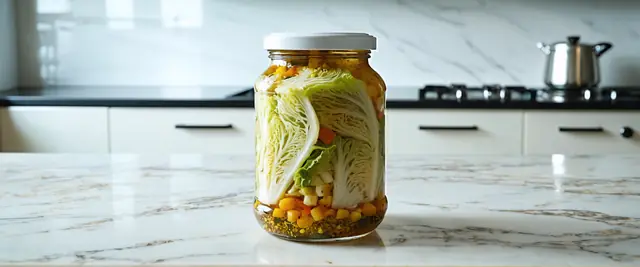
Tianjin Preserved Vegetable
Salted napa cabbage ferments into a tangy, crunchy condiment with deep savory flavor.
Dietary
Vegan, Vegetarian, Pescatarian, Wheat free, Dairy free, Nut free, Kosher
This home-fermented version of the classic Tianjin preserved vegetable relies on layers of salt to draw moisture from napa cabbage, which then ferments slowly into a tangy, umami-rich condiment. It is traditionally used to season stir-fries, noodle soups, and dumpling fillings, lending a salty-sour depth similar to Tianjin dongcai. Patience during the curing and fermenting stages rewards you with a jar of pungent, versatile seasoning that keeps for months.
Ingredients
- 4 pounds napa cabbage, outer leaves removed
- 1/2 cup coarse sea salt, divided
- 3 tablespoons garlic, minced
- 2 tablespoons fresh ginger, minced
- 1 tablespoon Sichuan peppercorns
- 2 tablespoons Shaoxing wine
- 1 tablespoon sugar
Method
-
Trim the napa cabbage, discarding any wilted outer leaves, and cut the heads lengthwise into quarters, then crosswise into 1-inch pieces.
-
Place the cabbage in a large bowl and toss with 1/3 cup of the coarse salt, massaging it into the leaves until they begin to soften.
-
Transfer the salted cabbage to a colander set over a bowl, weigh it down with a plate and heavy can, and let it drain at room temperature.
-
Squeeze handfuls of the cabbage firmly over the sink to press out as much liquid as possible, then spread the pieces on a clean towel.
-
Air-dry the squeezed cabbage on the towel, uncovered, turning once, until the pieces look slightly shriveled and leathery at the edges.
-
In a small bowl, stir together the garlic, ginger, Sichuan peppercorns, Shaoxing wine, sugar, and the remaining 2 tablespoons of salt.
-
Toss the dried cabbage with the garlic-ginger mixture in a large bowl until evenly coated.
-
Pack the seasoned cabbage tightly into a clean 1-quart glass jar, pressing down firmly to remove air pockets and leaving 1 inch of headspace.
-
Cover the jar loosely with a cloth secured by a rubber band, or use a fermentation lid, and set it in a cool, dark place to ferment.
-
Check the jar daily during fermentation, pressing the cabbage back under any accumulated liquid and checking for a pleasant sour, savory aroma.
-
Once fermented to taste, seal the jar with a tight-fitting lid and refrigerate; flavor continues to deepen over the following weeks.
Rate this recipe
Report this comment

Tianjin Preserved Vegetable
This home-fermented version of the classic Tianjin preserved vegetable relies on layers of salt to draw moisture from napa cabbage, which then ferments slowly into a tangy, umami-rich condiment. It is traditionally used to season stir-fries, noodle soups, and dumpling fillings, lending a salty-sour depth similar to Tianjin dongcai. Patience during the curing and fermenting stages rewards you with a jar of pungent, versatile seasoning that keeps for months.
Make ahead 32 oz 18 cal
Ingredients
- 4 pounds napa cabbage, outer leaves removed
- 1/2 cup coarse sea salt, divided
- 3 tablespoons garlic, minced
- 2 tablespoons fresh ginger, minced
- 1 tablespoon Sichuan peppercorns
- 2 tablespoons Shaoxing wine
- 1 tablespoon sugar
Method
- 1
Trim the napa cabbage, discarding any wilted outer leaves, and cut the heads lengthwise into quarters, then crosswise into 1-inch pieces.
- 2
Place the cabbage in a large bowl and toss with 1/3 cup of the coarse salt, massaging it into the leaves until they begin to soften.
- 3
Transfer the salted cabbage to a colander set over a bowl, weigh it down with a plate and heavy can, and let it drain at room temperature.
- 4
Squeeze handfuls of the cabbage firmly over the sink to press out as much liquid as possible, then spread the pieces on a clean towel.
- 5
Air-dry the squeezed cabbage on the towel, uncovered, turning once, until the pieces look slightly shriveled and leathery at the edges.
- 6
In a small bowl, stir together the garlic, ginger, Sichuan peppercorns, Shaoxing wine, sugar, and the remaining 2 tablespoons of salt.
- 7
Toss the dried cabbage with the garlic-ginger mixture in a large bowl until evenly coated.
- 8
Pack the seasoned cabbage tightly into a clean 1-quart glass jar, pressing down firmly to remove air pockets and leaving 1 inch of headspace.
- 9
Cover the jar loosely with a cloth secured by a rubber band, or use a fermentation lid, and set it in a cool, dark place to ferment.
- 10
Check the jar daily during fermentation, pressing the cabbage back under any accumulated liquid and checking for a pleasant sour, savory aroma.
- 11
Once fermented to taste, seal the jar with a tight-fitting lid and refrigerate; flavor continues to deepen over the following weeks.
Comments
Log in to comment.